0. Overview | 1. Student Profiles | 2. Discipline Contexts | 3. Media Choices | 4. Intended Learning Outcomes | 5. Assessment | 6. Learning Teaching Activities | 7. Feedback | 8. Evaluation
Before we explore the role that ILOs play in higher education design, there are two other terms to familiarise yourself with: aims and objectives. Academics use the term differently, so it is important to define our usage.
What are the Aims?
Aims outline the broad purpose or goal of a programme or module. They are not intended to be statements of what students will learn or do (that is the function of the ILOs), rather they summarise the overarching intentions of the course.
Very often, you will see the ‘aims’ also referred to as the ‘aims and objectives’ of a course of study. We prefer to use simply the term ‘aims’ alone because’ objectives’ denotes a historic style of learning design, and we use the term’ objectives’ differently now. Normally, ‘aims’ should be written in response to two questions:
- What is the purpose of this programme or course?
- What is the programme or course trying to achieve?
Aims should be succinct and provide students with a broad overview of what to expect from a given course of study.
Examples of Aims for four different modules
- To provide students with an opportunity to practice clinical skills.
- To provide a review of the historical development and current configuration of the legal system in England and Wales
- To challenge practitioners to reflect on their existing practice and allow them to evaluate alternative approaches.
- To support students in undertaking research into contemporary social-media marketing challenges.
In these single sentences, it is possible to summarise the aims of a given module.
I believe the aims should always be as succinct as possible. Sometimes it is necessary to explain why a particular course appears in a specific programme, or indeed why it might represent a generic ‘cross-level’ option in a range of programmes.
Aims: Core or Options
- In core modules, the aim is to provide students with a very brief idea of the course’s intended purpose. They should illustrate the course’s role in relation to the programme students are studying.
- In optional modules, the aims should help students decide whether to take the course.
What are the Objectives?
Objectives can be written for the faculty and assessors, though the more student-friendly the language is the better. The language used to describe education continuously evolves. Historically, when educational design focused on the teacher rather than the learner, course or programme descriptions often used objective-based terminology, which could be described as passive. As higher education has developed a greater focus on students’ learning, these claims would be better phrased as intended learning outcomes, as active intents on the part of the student.
| Passive (old) | Active (new) |
| “To introduce students to the theories of business strategy.” | “To enable students to be able to apply a range of theories relating to business strategies” |
Objectives are still worthwhile as a declaration of what the teacher intends to facilitate students in doing. However, we suggest that this is more useful at the session, topic or seminar level. Rather than asking the student to cope with learning outcomes for every session and risk undermining their engagement with the course ILOs, it is preferable to use alternative language. Objectives differ from outcomes in the 8-SLDF because objectives are never formally assessed, whereas outcomes always are.
As a consequence, the language of intended learning outcomes is only appropriate for formal and some non-formal learning contexts where there is an institutionally supported curriculum and implied or actual assessment. For informal or incidental learning, the vernacular use of the term ‘objective’ is appropriate. Watch this video of mine for an explanation of the terminology difference.
What are Intended Learning Outcomes (ILOs)?
ILOs are detailed explanations, written in language students will understand, before beginning the course or programme, of what they will be able to DO when they have successfully completed the learning.
Many quality assurance structures, institutional or external, require Programme and Course Specifications to contain details of the ‘intended learning outcomes’ (ILOs) of the programme of study. ILOs serve to provide students with a ‘checklist’ of the types of skills, attributes, abilities or competencies they should be able to evidence through successfully completing the module or programme.
Intended Learning Outcomes should not be seen as a straitjacket for faculty. Rather, if they are well written, they should provide scaffolding for creativity in teaching and assessment.
Most teachers can identify any number of unintended learning outcomes, depending on the character of the cohort, the changing context in which learning takes place or the emergent nature of the discipline. However, the ILOs are the facets of learning that will be assessed. They should be written with the understanding that these are the capabilities that will be assessed, not the content knowledge.
Universities have traditionally focused very much on the intellectual skills graduates are expected to develop through their studies. As important as these are, students themselves expect a broader range of skills. Employers expect a range of attributes above and beyond intellectual skills. (S. P. Atkinson, 2015)
It is important to incorporate a range of different domains of learning into our course and programme specifications. The focus of your learning will determine the balance of the ILOs you write, but I suggest all five should be present in each module. More on these later.
| Domain | Vernacular usage | Description | |
| Metacognitive | Describes the perspectives adopted by the individual towards the relationship between self and knowledge | intended to represent the ‘nature’ of the discipline regarding the personal-epistemological and metacognitive development of students | |
| Cognitive | often referred to as intellectual skills | refers to ‘knowledge structures’ in cognition, the progressively complex use of knowledge artefacts | |
| Affective | Sometimes referred to as professional ‘skills’ or attributes | perception of value issues, and ranges from simple awareness (Receiving), through to the internalization of personal value systems | |
| Interpersonal | Referred to as communication skills | Often referred to as ‘transferable skills’ | refers to progressively complex levels in interpersonal communication, conflict resolution, collaboration and cross-cultural communication |
| Psychomotor | Referred to as practical skills | refers to progressively complex manual or physical skills. This could be the ability to use a complex piece of software, instrument or paper documentation | |
You may see other formulations too. It is not uncommon to see ‘transferable skills’ as a generic term for skills deemed to be other than intellectual ones. The 8-SLDF advocates identifying ILOs in these five domains whenever possible. To give them appropriate weighting and importance in any university or professional programme is important. I believe all learning across five domains is ultimately transferable.
Structure of Learning Outcomes
The usual format for an ILO has three elements:
- an active verb,
- followed by the subject of learning,
- followed by the context of learning.
Illustrated below are two examples of ILOs for different disciplines across all five domains of learning, ten in total. We should read each with the pretext “On successful completion of this module, you will be able to…”
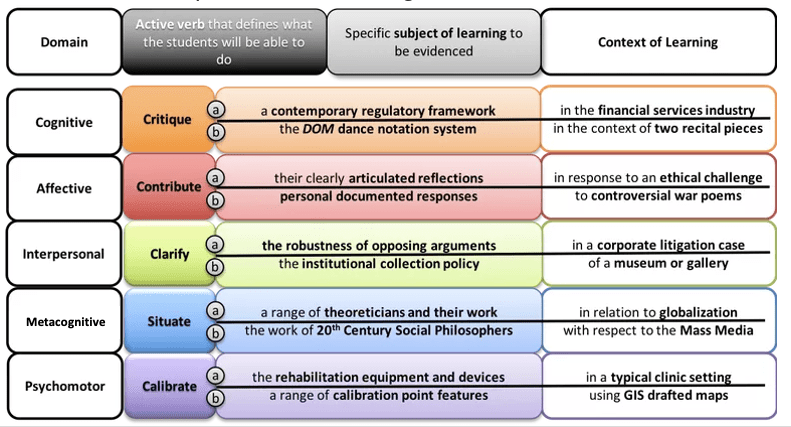
You notice ILOs are:
- written in the future tense, “students will be able to”
- begin with a single active verb. There will be some exceptions where the conventions of language dictate (such as the use of ‘compare and contrast’), but it is always preferable to try and write a single sentence with a single active verb
- using language that students will understand before they embark on the module, avoiding abbreviations and acronyms and where necessary spelt out or explained (DOM)
- describes an outcome, not a process (the scheme of work is where you describe the content)
- specific not detailed. The exemplar ILOs above deliberately don’t say which ‘regulatory framework’ or which ‘theoreticians’. These ILOs would stand even though the two elements were to change.
- achievable and measurable. All module outcomes should be assessed and passed
You should also be able to recognise that a good module and programme design:
- uses as many ILOs as necessary to reflect the breadth and depth of the course’s learning in the context of the programme as a whole;
- demonstrates that coordination across modules within a programme has occurred. This is important to ensure that the same abilities are not being repeatedly assessed at the neglect of others
Relationship between aims, outcomes and objectives
Here are two different modules that illustrate the relationship between aims, outcomes, and objectives.
| AIMS (Module Level) | AIMS (Module Level) |
| To enable students to practice and develop clinical skills. | To support students’ review of the historical development, and current configuration, of the legal system in England and Wales. |
| OUTCOMES (Module Level: Interpersonal Domain or ‘Communication Skills’) | OUTCOMES (Module Level: Cognitive Domain or ‘Intellectual Skills’) |
| On successful completion of this module, you will be able to: effectively interact with patients in a clinical context. | differentiate between the branches of the judiciary and articulate their respective roles in England and Wales. |
| OBJECTIVES (Session Level) | OBJECTIVES (Session Level) |
| To identify the appropriateness of questions designed to ascertain a patient’s history and symptoms. | To identify the roles of coroners’, ecclesiastical and military courts and their respective jurisdictions. |
ILOs are stage 4 of the 8-SLDF. Stages 4, 5, and 6 of the 8-SLDF should be regarded as deeply entwined and developed as a team in an iterative fashion. There are three elements of learning design that are essential as you work through these three stages: constructive alignment, levels, and progressive taxonomies.
Constructive Alignment
The reason that ILOs are regarded as the foundation of outcomes-based learning design is that they form the backbone of the constructive alignment of any course of study.
Whilst the ILOs provide students with a ‘checklist’ of the types of skills, attributes, abilities, or competencies, they should also define the nature of the assessment and the learning activities. The same active verbs will describe the skills which will be assessed. It also follows that these ‘verbs’ are what should be taught.
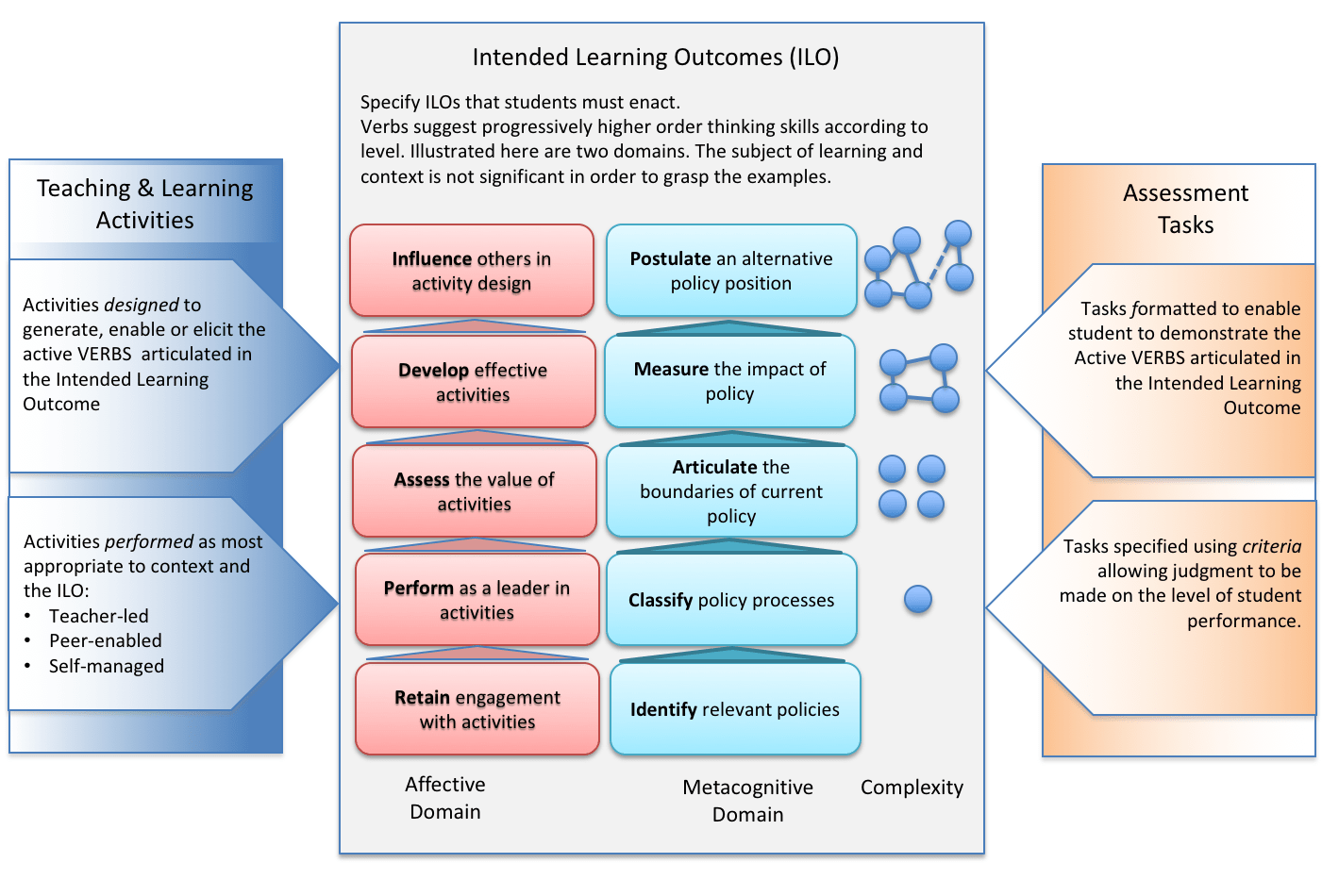
Given that all ILOs in a module must normally be passed, it is important that you are realistic in how you intend to allow the student to evidence their achievement of them, in other words, how you plan to assess them. We explore this in Stage 5 of the 8-SLDF, which deals with assessment.
Ideally, a course should be designed with the ILOs first, then an assessment strategy, and finally the learning activities and associated content.
Levels, Benchmarks and Professional Standards
As well as being aware of the notion of constructive alignment, it is also important to remind course designers that they need to craft their outcomes in line with their quality assurance agencies’ guidelines on levels, subject or discipline benchmarks and professional standards.
Levels
Intended Learning Outcomes are designed to reflect the level at which a subject is being studied. The language used should reflect the increasing level of complexity, regardless of the domain involved, as the students engage in the course or across a programme. Levels, as defined by the Quality Assurance Agency for Higher Education (UK), are set out below.
| UK Exit Awards | QF-EHEA | |
| Level 8 | Doctoral level qualifications e.g. PhD, EdD, DClinPsyc | Third cycle (end of cycle) qualifications |
| Level 7 | Masters degrees Integrated Masters, Postgraduate Diplomas, Postgraduate Certificate in Education (PGCE), Postgraduate Certificates | Second cycle (end of cycle) qualifications |
| Level 6 | Honours degree Professional Graduate Certificate in Education (PGCE) | First cycle (end of cycle) qualifications |
| Level 5 | HNDs, Diplomas of Higher Education and Foundation degrees | Short cycle (within or linked to a first cycle qualification) |
| Level 4 | Certificates of Higher Education, HNC |
The QAA Framework for Higher Education Qualifications contains ‘descriptors’ at each level. As a programme or module leader, or course designer, you should be familiar with these statements. Below is just one example of how the descriptor level changes a similar outcome with increasing complexity as a student moves up levels.

Benchmarks
In the UK, in addition to generic statements about the abilities of graduates on completion of their programme of study at a given level, the QAA also coordinates experts from across institutions to draw up benchmark statements for individual discipline areas. This ensures that there is some degree of parity between, say, doing a history degree at the University of Hull and at the University of Manchester. These benchmarks are not overly prescriptive, allowing institutions to provide distinct flavours to their qualifications, but they do mean that a future employer and the student themselves know broadly what is expected in any given discipline area. If you are a programme or module leader, you should ensure you are familiar with the relevant benchmark statement in your discipline.
Professional Standards
Many degrees are taught with specific professions in mind, such as business, architecture, law or health. These professions are heavily regulated, so degree programmes are often required to conform to external professional guidelines or standards.
One difficulty is that, as the language of learning design has evolved, some of the professional standards are written in the language of ‘training’, using the term ‘competency’ without further clarification. In higher education, there is an ongoing debate, even among English-speaking countries, about how to differentiate between competencies, attributes, and outcomes.
In higher education, it can take some effort to interpret the standards into the language of ILOs. Very often, it makes sense to reproduce the professional standards in your Programme Handbook (and specification), number them, and provide a table that articulates how each professional competency or standard is met through a specific ILO.
What is clear is that, very often, professional competency standards emphasise abilities that cannot be defined as ‘knowledge’ or intellectual skills (cognitive). Abilities such as teamwork (interpersonal) and ethical behaviour (affective) are frequently featured. It is always worth exploring ways to embed these abilities in your courses, and I suggest that if you write outcomes and assess these skills, your students and their future employers will be grateful!
Progressive Taxonomies
I have already talked about active verbs and the use of five distinct taxonomies. I want to explain this a little more, but here isn’t the place. To learn about all five domains of learning, I invite you to explore another area on this website, listed under research labelled ‘Educational Taxonomies’.
Summary
- ILOs are best written in conjunction with colleagues. A team approach is strongly recommended. You may also want to include existing students in the process. It can be a valuable learning experience.
- Make a list of what attributes you anticipate your module will deliver to students on successful completion. Don’t worry about the language at this stage; make notes.
- Work with others to define what style of attribute you are describing. Is it a highly skilled practice (higher level psychomotor), or a definable body of knowledge that simply needs to be learnt (lower level metacognitive), or is it a teamwork or collaborative skill that’s intended (Interpersonal)? Try not to feel compelled to make everything an intellectual skill (cognitive) just because it is higher education, and that is the current convention.
- Even if you don’t ultimately use all the draft outcomes you come up with, try to write a couple for each of the five domains.
If you have a body of knowledge already in place, or are working with a prescribed curriculum, try writing your ILOs backwards. By this I mean you make a list of all the contexts of learning, then the subject of learning and then decide what you want the student to do.
Final Thought
Please do not copy and paste pre-existing ILOs into your documentation. You owe it to yourself and your students to design their learning.
Here are a few ‘poor’ ILOs I have worked to improve. Start each one with “on successful completion of this module, you will be able to….”
| Poor ILOs (hard to meaningfully assess) | Good ILOs (concise, flexible and assessable at the appropriate level) |
| Knowledge of the Napoleonic Code | Articulate the scope and impact of the Napoleonic Code as it pertains to a specific code (Interpersonal Level 5) |
| Understand Newton’s Third Law | Demonstrate Newton’s Third Law under experimental conditions (Psychomotor Level 5) |
| Understand why some religions condone the death penalty and some do not | Justify two opposing positions with respect to a contentious practice on the basis of faith (Affective Level 6) |
| Use SPSS as a beginner | Perform simply data manipulation acts using a specialist quantitative analysis software programme. (Psychomotor Level 4) |
The poor ILOs are nearly impossible to assess meaningfully as written. They would require significant recontextualizations; otherwise, a student could say, “yeah, I know what the Napoleonic Code is, thanks…” The rewritten ILO sets the level through an appropriate active verb, ‘articulate’, sets the specific subject, ‘scope and impact of the Napoleonic Code’ and the context, which is flexible, stating deliberately ‘a specific code’ rather than referring explicitly to property, family, individual rights and so on. This allows faculty to refocus learning without redefining their outcomes.
I invite you to identify whether my ‘good’ ILOs overcome the deficits of the ‘poor’ versions on the left. Feel free to leave a comment.